Construction schedules create specific trades, apprenticeship and supervision requirements.
Nine Autonomies · One connected system
The CDMM System Effect
The system view makes shared people, assets, infrastructure, reinforcing relationships, trade-offs, delays and common risks visible across all nine fields.
Accessible media
Watch / Listen
Use the narrated film, audio-only playback, English captions or complete transcript.
Watch with captionsThe CDMM System Effect · 00:39
Listen to the narrationAudio-only playback · no autoplay
Download captions Download transcriptMaster architecture graphic
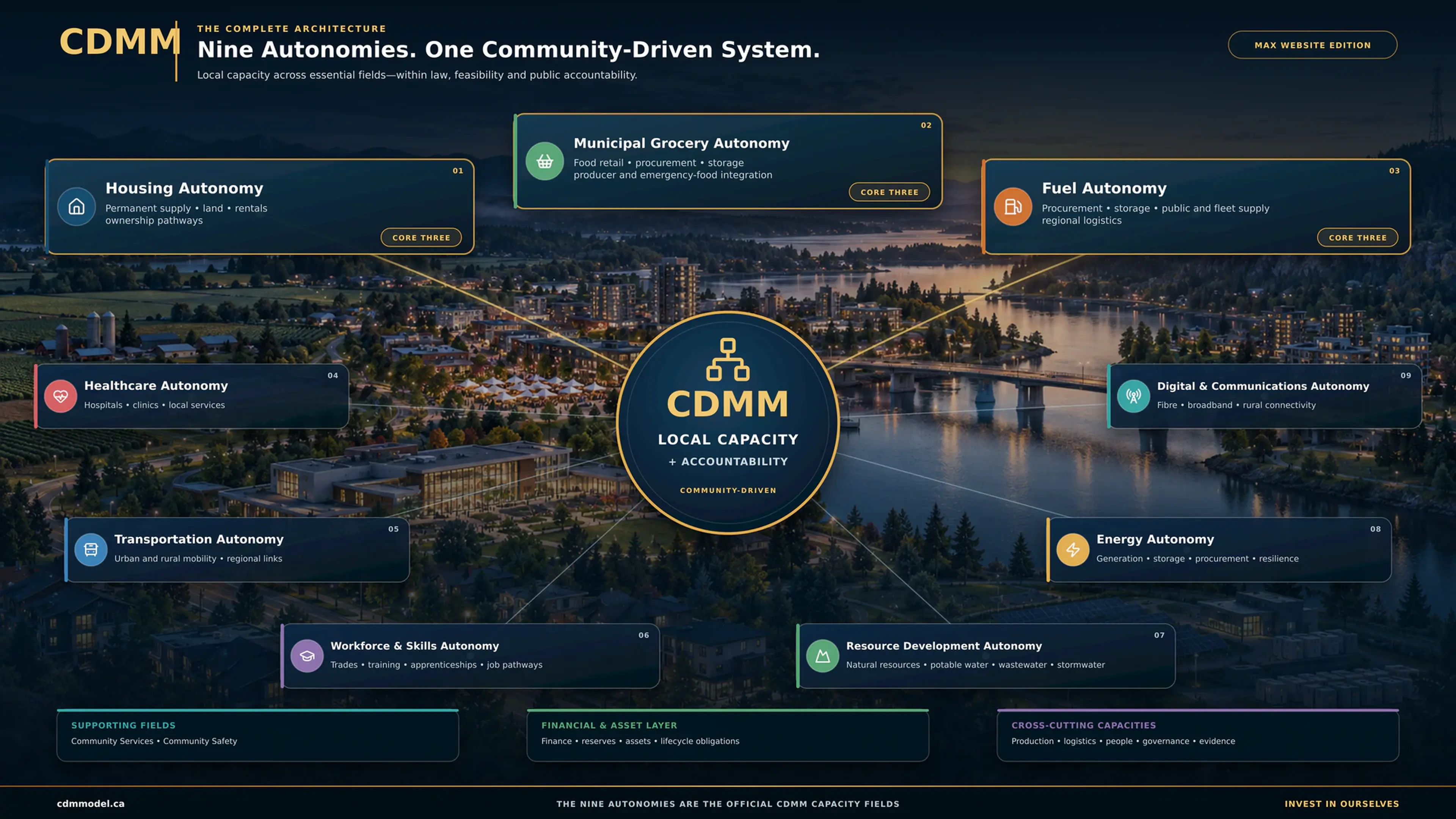
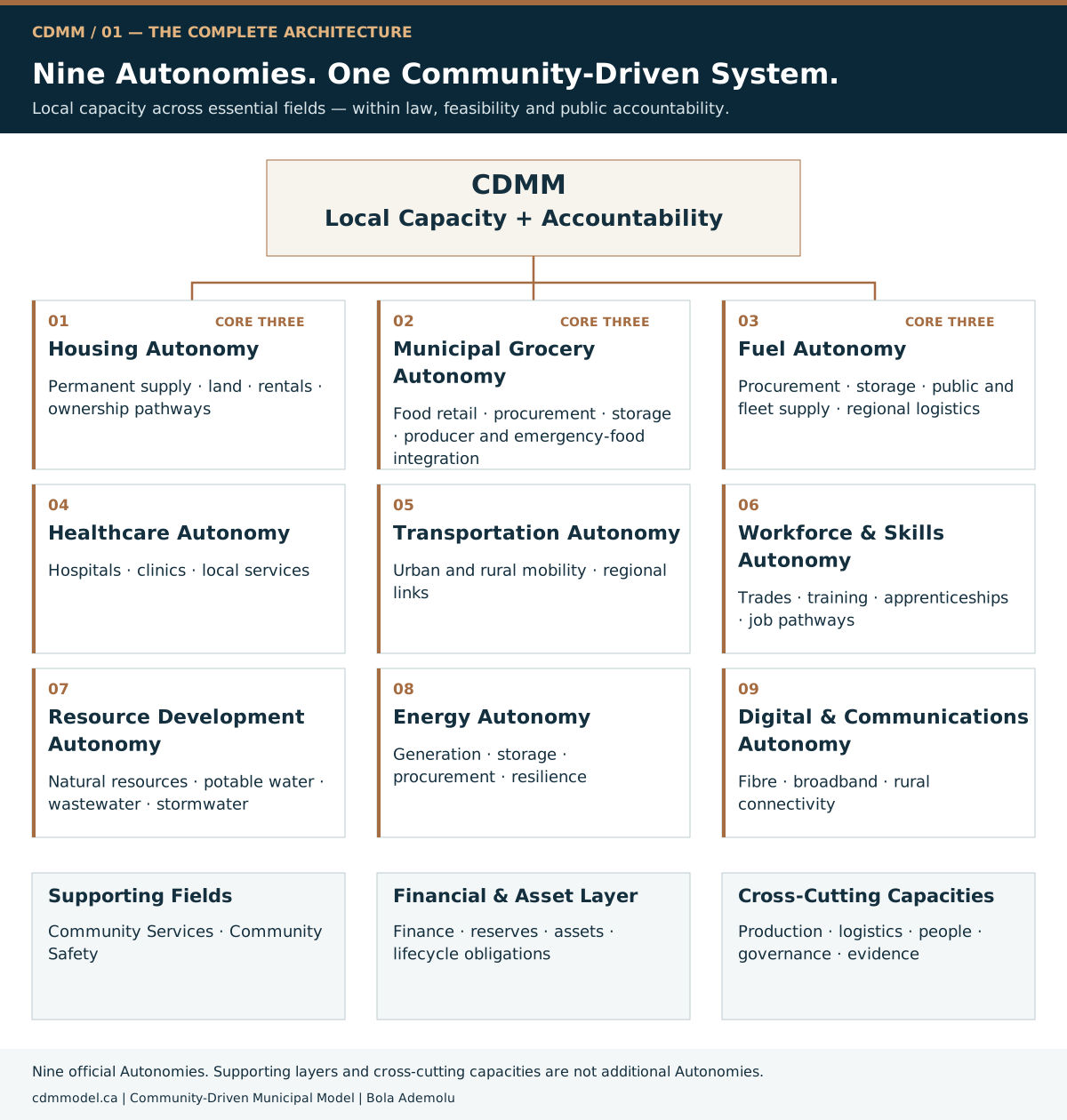
CDMM — The Complete Architecture
Nine Autonomies. One Community-Driven System.
Nine Autonomies. One Community-Driven System.
CDMMLocal Capacity + AccountabilityCommunity-Driven Municipal Model
Nine connected capacity fields
- 01Core Three
Housing Autonomy
Permanent supply · land · rentals · ownership pathways
- 02Core Three
Municipal Grocery Autonomy
Food retail · procurement · storage · producer and emergency-food integration
- 03Core Three
Fuel Autonomy
Procurement · storage · public and fleet supply · regional logistics
- 04
Healthcare Autonomy
Hospitals · clinics · local services
- 05
Transportation Autonomy
Urban and rural mobility · regional links
- 06
Workforce & Skills Autonomy
Trades · training · apprenticeships · job pathways
- 07
Resource Development Autonomy
Natural resources · potable water · wastewater · stormwater
- 08
Energy Autonomy
Generation · storage · procurement · resilience
- 09
Digital & Communications Autonomy
Fibre · broadband · rural connectivity
Supporting Fields
Community Services · Community Safety
Financial & Asset Layer
Finance · reserves · assets · lifecycle obligations
Cross-Cutting Capacities
Production · logistics · people · governance · evidence
Select a field to reveal its major operating relationships.
CDMMNine Autonomies
Selected field
Housing Autonomy
Permanent housing, land, construction, stable rental and ownership pathways.
Open full analysisPotable water, wastewater and stormwater capacity determine safe development yield and timing.
Building efficiency and electrical capacity shape household and municipal lifecycle costs.
Location determines access to work, food, care and training, changing total household cost.
Serviced land needs reliable connectivity and coordinated conduit.
Stable housing supports health while proximity to care and food affects suitability.
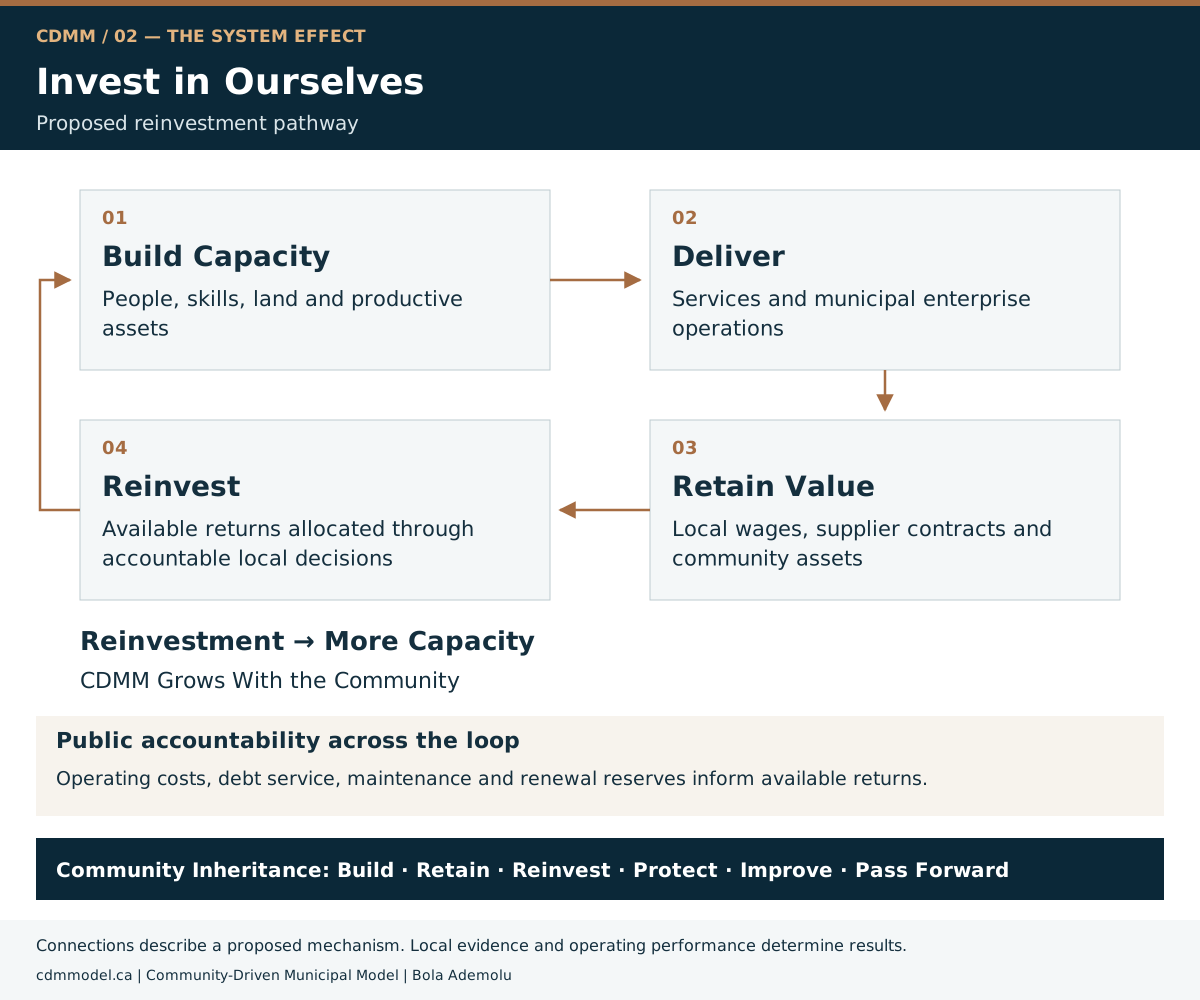
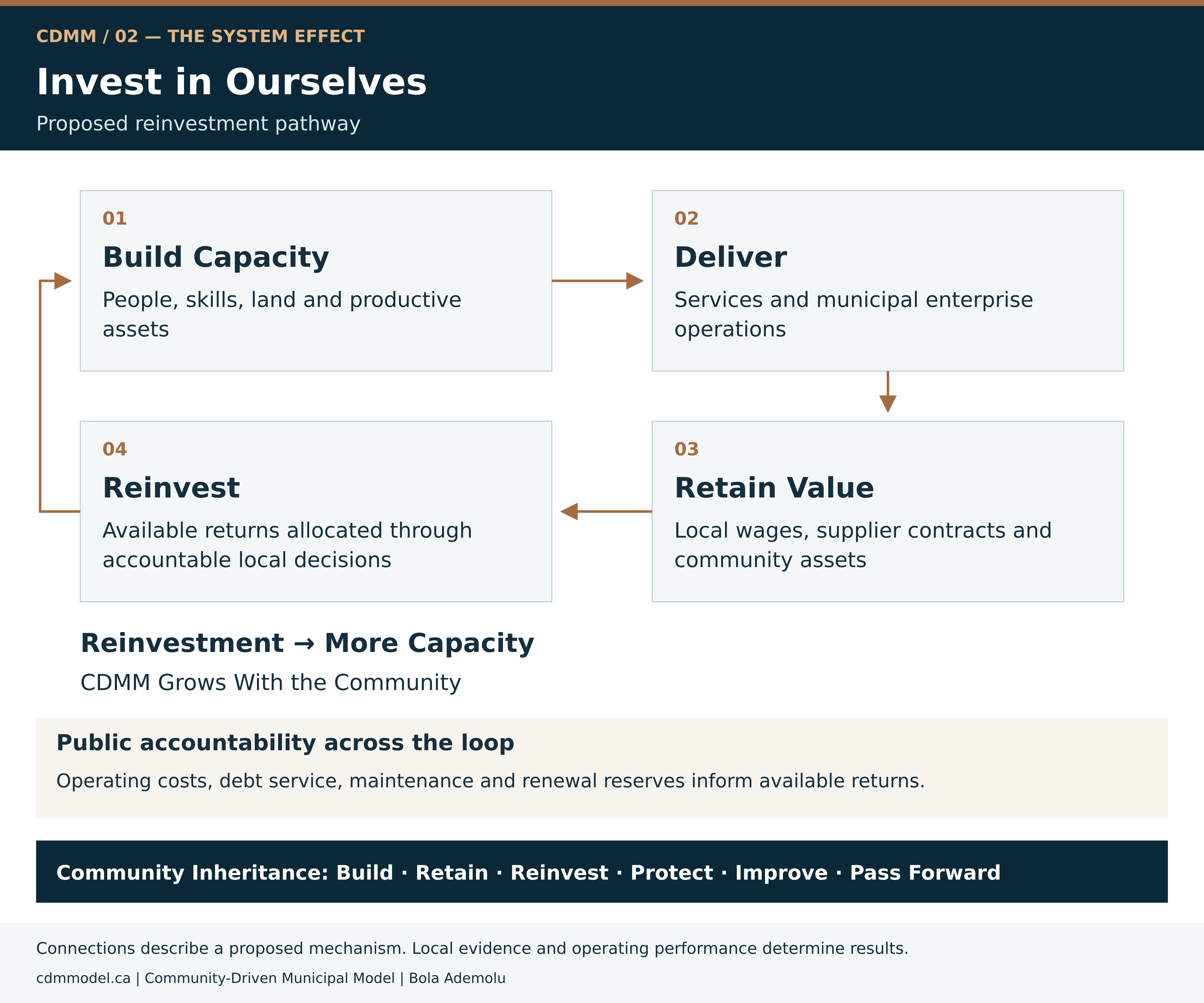
Invest in Ourselves
The CDMM System Effect · proposed reinvestment pathway
- 01
Build Capacity
People, skills, land and productive assets
- 02
Deliver
Services and municipal enterprise operations
- 03
Retain Value
Local wages, supplier contracts and community assets
- 04
Reinvest
Available returns allocated through accountable local decisions
Reinvestment → More CapacityCDMM Grows With the Community
Public accountability across the loop
Operating costs, debt service, maintenance and renewal reserves inform the returns available for reinvestment.
Build · Retain · Reinvest · Protect · Improve · Pass ForwardCommunity Inheritance
Operating relationships
Connections create both capacity and responsibility
Reinforcing relationships
Stable housing can support health, work and training. Skills capacity can improve construction, utilities and operations. Connectivity can strengthen every field.
Shared infrastructure
Land, water, energy, transport, logistics and data can serve several fields when capacity, cost allocation and priority rules remain explicit.
Common-mode risks
A labour shortage, power failure, cyber incident or capital constraint can affect several fields at once. Dependencies belong in planning and reporting.
CDMM’s integrated effects are a proposition to test.
Individual mechanisms have precedents. Their combined outcomes, economic returns and reinforcing effects require local evidence and scenario analysis.