Barrier cycle
01Instability
02Survival Demands
03Reduced Opportunity
04Underparticipation
05Capacity Unseen
06Continued Instability
The human foundation
Communities already contain knowledge, ability, creativity, lived experience, skills and productive potential that barriers can leave unseen or underused.
Accessible media
Use the narrated film, audio-only playback, English captions or complete transcript.
Controlling principle
Barriers to participation
Instability can consume time and energy that people would otherwise use to learn, work, create, care, organize and contribute.
Barrier cycle
People as a Productive Resource
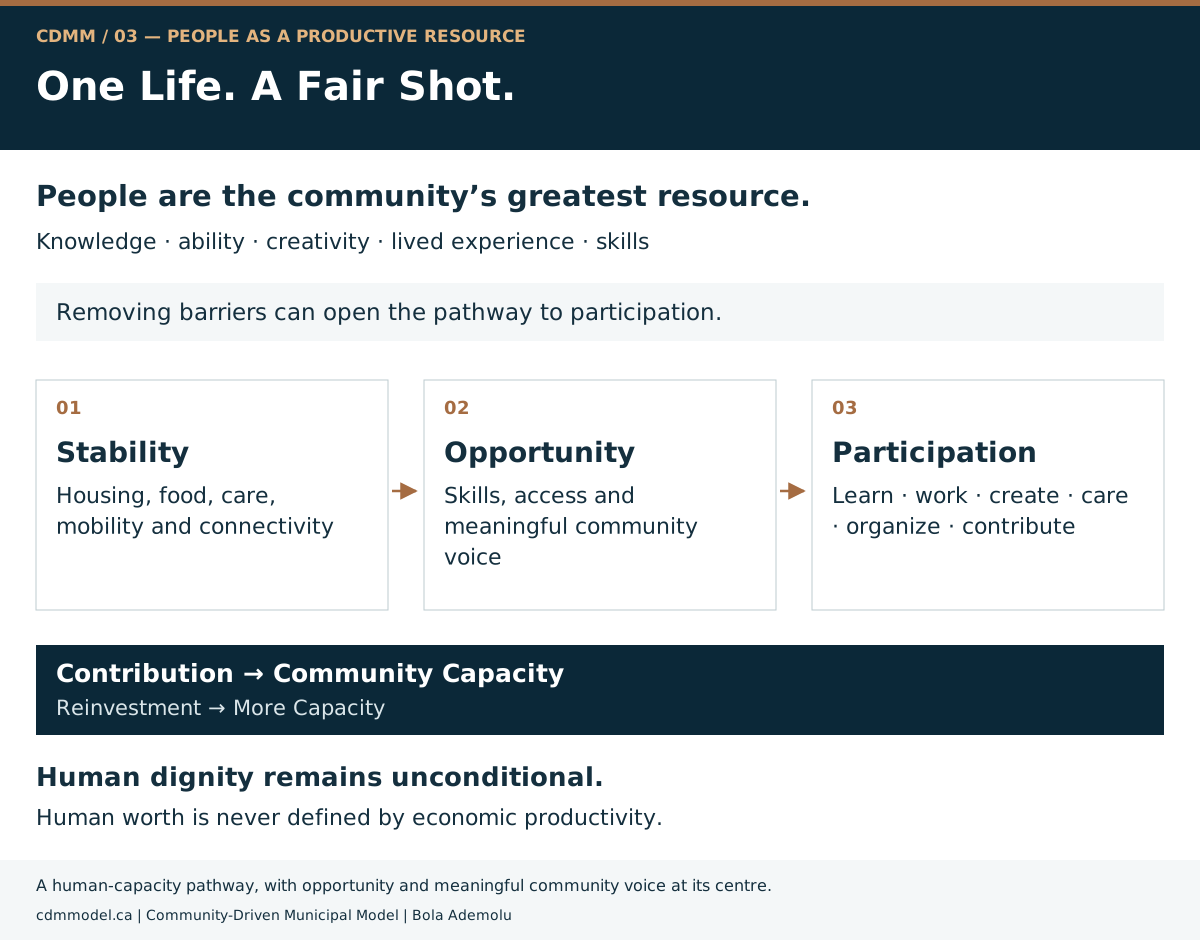
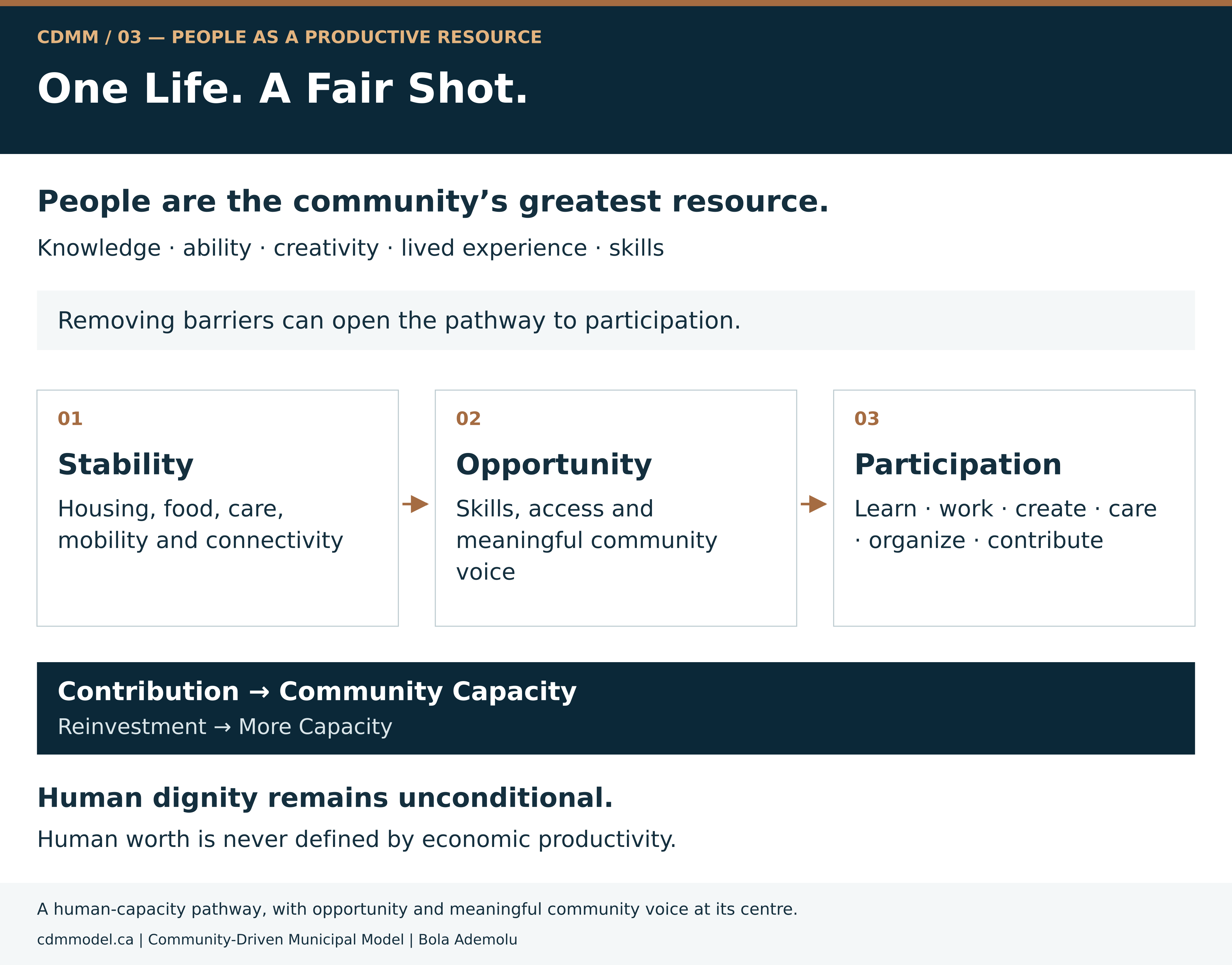
Knowledge · ability · creativity · lived experience · skills
Housing, food, care, mobility and connectivity
Skills, access and meaningful community voice
Learn · work · create · care · organize · contribute
Human worth is never defined by economic productivity.
Lived experience and development
Bola Ademolu, Courtney, Romeo and other people who experienced being less fortunate contributed lived experience, discussion, ideas and community knowledge that helped shape Foundational Homes, Municipal Tiny Homes and the push toward ownership.
These ideas did not emerge solely from institutions, professional offices or universities. Community discussions involving people facing housing insecurity and homelessness preserved the importance of permanent housing, ownership, secure rental where desired, rent-to-ownership, land, construction capacity and alternatives to endlessly expanding temporary responses.
This history is not a story of individual heroism. It demonstrates the larger CDMM principle that communities may already possess valuable human capacity that existing systems are failing to recognize and enable.
Housing Autonomy and its provenanceImagine the human capacity communities could unlock if fewer people had to spend so much of their one life overcoming barriers simply to participate.
It can create the conditions in which previously underutilized human capacity becomes visible, active and capable of contributing to the community.